
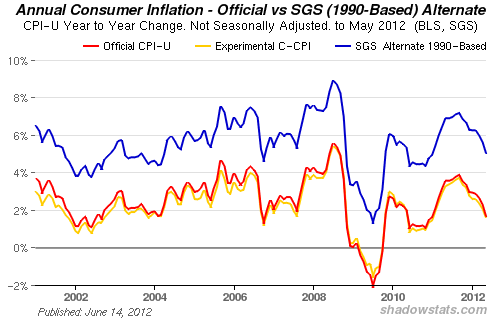
 (Community Matters) inflation is being reported as less than 2%, but by the 1980s formula, it’s almost 10%. Is high inflation squeezing US consumers?
in Marfa for a McDonald Observatory board of visitors weekend as well as for Marfa Public Radio. My house guest is John Del Vecchio, a portfolio manager of a short fund and an author. So, not hard to imagine us discussing the difference between core & headline inflation and why any government reported inflation numbers are or aren’t accurate (at least within historical context). John’s introduced me to a site: Shadow Government Statistics which I find fascinating and to which I’ve just subscribed.
 for instance, while the official inflation rate is under 2%, if we use the 1990 government definition, it’s 5%. It is almost 10% as measured by the 1980 definition. There are strong arguments that the latter most accurately reflects inflation as experienced by consumers
a friend and smart economist wrote and referred me to the Boskin Commission Report, suggesting that the definition was good and the newsletter bad. I’ve noted that other economists think the adjustments for hedonic indexing of technology products in the new definitions of inflation skew the results too significantly for consumer measure. I don’t sense families feel like inflation is below 2% as they contend with rising energy and food costs. As it usually does, I’m sure the truth lies somewhere in between.


 Community Matters
Maybe this is a good thing, if it slows cost-of-living increases in entitlements. Keeps Social Security and military pensions from going up even faster than they are.
It’s the cost of supporting retired people that is going to bankrupt our society. Not lack of innovation or decline in manufacturing or bad schools. The problem is especially bad when state and local government employees get substantially better retirement plans than their counterparts in private industry. Something has to change.