
 (Community Matters) Thought I’d post the latest HelpHaiti email update I just sent to family & friends who have donated and had their contribution matched dollar for dollar.
Good morning ALL,
Just a quick update on the HelpHaiti Fund. For those of you new to the list, there’s a long email trail below with the periodic updates to family and friends who have donated.
We’ve busted the $200k raised against the $600k match – so apprx $800k raised to date – and hope to announce this week a very sizeable additional gift. Many thanks to the Four Seasons employees, CharityBash and UT students who each raised substantial funds ($10k, $4.7k & $26k) in grass roots efforts – all now double their original raise! 🙂
As a reminder, we’re committed to the notion that the people of Haiti need us to remember them 6 months after the earthquake as much as immediately thereafter. When we raised the $500k for Katrina Relief, about half the money was raised in the first 30 days, a quarter the second 30 days and the final quarter in the next 3 months.
We’re in contact with our primary partners in Haiti – Partners in Health (@PiH_org), Concern Worldwide (@Concern) and Catholic Relief Services (@CatholicRelief). Each of these groups have moved from emergency relief into short & intermediate humanitarian aid, especially setting up temporary housing, distributing food & water and are each trying to establish some “normalcy” to the lives of millions. The rainy season is starting and the drive to get folks into tents and other temporary housing outside the rains is critical. People are weak, traumatized and vulnerable. These partners are also launching cash for work programs to inject money back into the system. We’ve assessed the cash positions of these partners (each who have been working in Haiti for decades and have outstanding direct help to administrative exp ratios) and are monitoring their progress.
Just over a week ago, we offered $50k challenge grants to all three agencies to further empower their fundraising. Exciting responses: Partners in Health are leveraging your monies to match university students’ fundraising from 100 campuses around the country; @Concern is targeting additional rounds of fundraising from supporters with your match; and @CatholicRelief has launched additional Austin-based fundraising appeals. If using your already leveraged donations can yield even more matches, we could extend and increase the challenge grants.
As a reminder, after reviewing information from our HelpHaiti partners and discussing the unique place for HelpHaiti to assist, we’ve prioritized five areas of support (in addition to the early emergency relief grants):
- Food & water
- Shelter – (temporary housing)
- Health & sanitation
- Education & schools
- Economic empowerment
We continue to research where your monies will have the most impact in education & schools and economic empowerment. We’re following the economic empowerment initiatives of @Fonkoze and a new initiative being launched, Zafen.org.
It’s important to us that your generous donations be leveraged and deployed strategically to have the greatest impact assisting those so devastated by the earthquake. We’ll continue to forward periodic updates, though feel free to let me know if you’d prefer to be left off this list.
Immediately below, I’ve posted some updates from our partners
Appreciatively,
Eugene
on behalf of EF and our match donors (Austin Ventures, the Berbers, Wellands, Merediths, Garbers & Silicon Labs)
Partner Updates (taken from their blogs, emails and tweets):
@PiH_org
Much focus on psychosocial and physical therapy assistance in addition to running camps for thousands. As part of long term efforts to treat (and prevent) the earthquake’s severe psychological effects, the Zanmi Lasante (ZL) psychosocial team is working with physicians, patients, and the Ministry of Health (MOH). Father Eddy Eustache, ZL Psychosocial Program Director and the Chair of the Committee on a National Mental Health Service Plan is working with the team to install a social worker at each of the mobile clinics in Port au Prince (PAP) and increase their presence at PIH sites. In addition, in order to better equip the ZL team to recognize and treat psychiatric symptoms, a team of visiting psychiatrists conducted training on 24-hour crisis management and another on basic psychiatry with doctors and nurses in Cange. Physical therapy activities are also ramping up. Teams of volunteer physicians arrive regularly (PIH has sent 365 staff and volunteers to date) and experts in physical therapy (PT) are now playing larger roles on these teams. We are also planning for permanent placements at existing PIH facilities, and the four mobile clinics we are operating throughout Port au Prince (PAP). A five member team from Dartmouth University recently conducted an overall PT needs assessment at St. Marc, Hinche, and Cange, the three sites most impacted by the quake. The team concluded that current ZL staff are well trained and knowledgeable about PT, but given our increased needs over the next months and years, that additional staffing is immediately necessary. They, along with Dr. Koji Nakashima a PIH physician who is now the point person for rehabilitative care suggested that three full time physical therapists be stationed in Hinche and 6-8 each in Cange and St. Marc. Our expansion of post-operative capacity will be on going so that we are able to continue responding effectively and efficiently.
@Concern
From Dominic (@aidwkr): have just spent the day visiting Concern’s emergency team in the poorest areas of Port-au-Prince. It was a long, hot day—but it was a great day. I feel very energized and excited about what we have been able to achieve in the past few weeks, and also excited to be able to tell you how your support is allowing us to make a real and immediate difference here. We have a great team of more than 250 staff now working in Port-au-Prince; 230 of them are Haitian, and we are recruiting more every day.
It’s one of the strongest, most experienced teams we have ever been able to assemble for an emergency, with people like Per Andersson, our Emergency Engineering Manager, who is more experienced in water and sanitation than anyone else I know; Tom Dobbin, who has being doing large-scale food distributions in emergencies in Africa for 20 years; Kate Golden, who has led Concern’s emergency health and nutrition programs for the most vulnerable malnourished children on the frontlines in the Darfur region of Sudan, Ethiopia, South Sudan, and Democratic Republic of the Congo; Ted Shine, who has worked in every large-scale emergency around the world in the last 10 years; and many more. It’s an impressive team–and we need every single one of them because we have a huge job to do.
There is nothing fancy and nothing small about what we are doing here –we are simply ensuring that thousands of families have the bottom-line basics for survival. We are already providing clean water and latrines to over 50,000 people and more than 30,000 have received a shelter kit, blankets, jerry cans and a hygiene kit. Thousands of children have been screened for malnutrition and in the coming weeks we will be providing 15,000 children with supplementary food. We are providing education for 30,000 children and seeds, tools and goats for 5,000 farmers. Teams of workers have been employed on cash-for-work: 15,000 will be reached in total.
The areas where we are responding now are the same areas in which we have been working for years: Port-Au-Prince, La Gonave and Saut d’Eau. All of them tough, remote and deeply poor. The most affected and most challenging areas are the slum communities in the city of Port-au-Prince, in particular the areas of St Martin and Martissant.
On distribution day, for the particularly difficult neighborhoods, security is provided by the 82 US Airborne, who guarantee a degree of order and control that we simply aren’t equipped to handle. Smiles indicate that the wait was well worth it. It’s tough work that sometimes feels more like Beirut or Belfast in the 70s, but the formula works, and when I visited today, it meant that 1,300 women were able to safely collect plastic sheeting, blankets, jerry cans, water treatment tablets, soap, and shampoo. The smiles on their faces said it all.
But shelter isn’t the only thing we distribute: water distribution has been a big priority from day one of the operation. Our “wat-san” team proudly announced that, as of yesterday, using eight water truck and bladder tanks installed in key locations around the city, Concern is now providing 188,500 liters of clean drinking water to 53,000 people every day! I am very proud of how we are working and what we are doing, and I am deeply grateful for the support we receive that allows us to do this and more. Please check in tomorrow for more updates on our cash for work and nutrition programs, which you have made possible.
@CatholicRelief
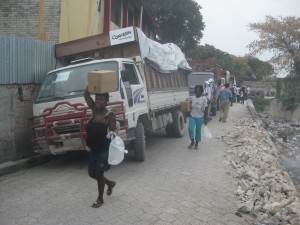
As Haiti paused to mark the one-month anniversary of the earthquake that devastated its capital city of Port-au-Prince, Catholic Relief Services reached our own milestone—providing food to a half-million people in the country. CRS donors continue to demonstrate their care for the people of Haiti, giving or pledging $60.4 million for relief operations. Now attention is turning to providing shelter as the rainy season looms a month or so away. Catholic Relief Services delivered tons of World Food Program rice—supplied by the U.S. Agency for International Development—to Haitians at a camp for displaced people in Port-au-Prince. Photo by Lane Hartill/CRS
During a three-day period of prayer beginning February 12, Haitians across the country took time to observe the one-month marker. Singing could be heard across the city, coming from formal and makeshift churches, from camps and settlements, from people walking to and from prayer services, and even from the CRS offices where a handful of Haitian staff members worked over the weekend.
CRS distributed emergency shelter kits—waterproof sheeting, lumber and nails—to an estimated 6,500 families (about 32,500 people) at the Petionville golf course, where close to 50,000 people now live under sheets and other materials that will be useless as protection once the rainy season begins in March. The week of February 15, CRS will be distributing 10,000 more of these shelter kits to families in smaller camps and settlements, and at Champ de Mars, the grassy area in front of the heavily damaged government buildings in the center of Port-au-Prince.
Even as we undertake these distributions, CRS personnel are at work on more substantial—if still temporary—solutions to the housing problem, identifying sites more suitable for camps and employing designs for improved accommodations.
Work on health projects continues at St. Francois de Sales Hospital, which CRS helped get up and running in the days after the quake. The hospital sees a steady rotation of doctors and nurses from the University of Maryland conducting up to 20 operations a day. CRS and the University of Maryland are both members of the AIDSRelief consortium that had been working at St. Francois de Sales treating patients with HIV prior to the earthquake. CRS has also set up teams of doctors, nurses and practitioners to run nine health sites across the city, some in informal camps, others in clinics.
CRS water and sanitation workers are busy with various activities—developing radio spots on ways to avoid disease, getting proper sanitation services installed at St. Francois de Sales, beginning the installation of 400 latrines at the Champ de Mars site, as well as planning several other projects.
CRS reached the half-million mark by feeding people in many different ways. In the first few days after the January 12 quake, we handed out emergency supplies that were already in place in a warehouse in Les Cayes—a Haitian town on the southern coast that did not suffer great damage in the quake—and in neighboring Dominican Republic. They were ready for use in the event of a hurricane, but instead fed victims of the 7.0-magnitude quake.
Though the port in Port-au-Prince was heavily damaged, CRS was able to unload a shipment of supplies from the U.S. Agency for International Development’s Food for Peace program. Once we had trucked the shipment out over hastily repaired roads that the quake had rendered impassable, a voucher system was set up at the massive camp for displaced people at the Petionville Club. Some 50,000 people got enough food for two weeks. The distribution went so smoothly, the system was adopted for use by all the agencies handing out food.
The World Food Program divided Port-au-Prince into 13 areas for distribution of rice provisions, asking CRS to handle three locations. CRS has completed distributions in two of those areas and will finish up the week of February 15.


 Community Matters