
 (Community Matters) On Tuesday, I rode over with Jennifer Jalovec and Brion Loinsigh to Concern Worldwide’s ground up planned camp in Tabarre, a municipality in the “greater metropolitan area” of Haiti. Jennifer is Concern Haiti’s emergency coordinator, Brion a newly arrived program support officer; Ghi was our driver.
Don’t know that I’ve mentioned the tightness of security. You must drive in agency cars with doors locked and always with agency or other hired drivers – like most agency workers, these are employed Haitians paid USD $200 to $400 per month (the highest paid at the UN I’m told). Though not nearly as bad as in 2004/2005, kidnapping is on the rise, particularly of foreign aid workers. Trying to save the agency bother & since I arrived in Haiti on Monday several hours later than others, I tried insisting I’d take a cab and meet up with the group. Evidently, this is a very popular place from where to kidnap foreigners. and, I digress . . . .
 Tabarre – so we’ve toured a couple other camps. I’d seen a rather large one immediately outside the airport. According to Concern’s global emergency services director (the acting in-country director during my visit) Aine Fey, the UN estimates there are over 1300 housing 1.5mm to 1.7mm displaced people. Only about 21% of these are agency managed, so about 1,000 are what they call spontaneous camps, you’ve seen them on television & in the newspapers – in the middle of the road, on the side of a busy road, just outside the airport. I’ve assumed the latter or
  sometimes more easily identified by the more rudimentary forms of temporary shelter and the lack of any space between units. I’m told some where given port o toilets but temporary housing grew up surrounding these and there is no way to empty the units (sanitation is a huge issue here. HelpHaiti prioritized its funding along with medical assistance. And, nearly everyone here cites the lack of outbreak of major disease as attributable to safe drinking water and sanitation management – Concern spends USD $7,000 per day on water alone at its 13 managed camps & others to which it delievers safe drinking water).
Again, Tabarre, I think I’m postponing describing what I saw because I don’t want to trivialize life in a camp. Everyone of them has rising violence – especially gender based violence. Life in tents, lean tos, space covered by cheap or industrial tarps, sometimes just cheap plastic – it is oppressively hot here, it rains in buckets, we’re entering hurricane season. Life is not good in a camp. People shouldn’t have to wake up completely soaked, sleep with one eye open, queue up for beggars rations . . . . yada yada yada. . . . and yet, thank god so many have contributed so much so that nearly all the camps are receiving some sort of help (the 1000+ spontaneous camps aren’t allowed into the UN complex however and can’t access those coordinated services, yet other agencies help with water, roving medical, food, etc). And Tabarre . . . Concern’s Tabarre camp for 500 families . . . it felt like driving up to a planned community, which in fact it is.
Concern negotiated with the government to establish this camp on they’re calling transitional shelter following UN cluster guidelines to seismic resistance, hurricane resistance (category 3 though building the more “permanent” shelters to category 5), fire, flood, termite resistance, allowing for special needs. They laid out over 20 acres of white rock as a base, set up spacious tents for each of the 500 families on relatively spacious footprints. They included the neighboring community (the “host community”) in the planning and are offering services, rebuilding, medical and other assistance not only to the new camp residents but also to the 700+ families in the host community.
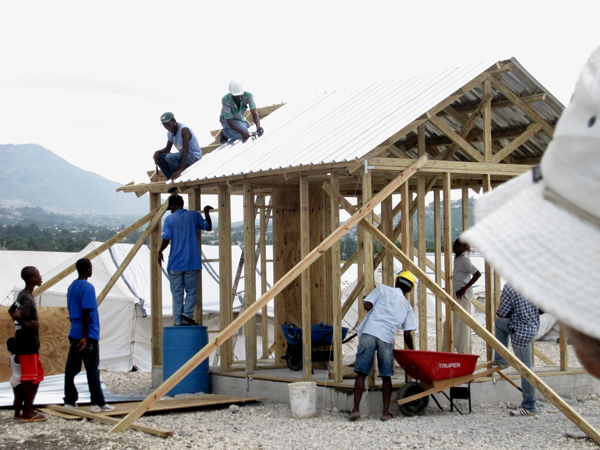 They are building the more “permanent,” officially transitional housing to their own established standards, forgoing UN and ECO monies because they’d allot only $1.5k USD for these structures. Concern’s engineers determined it costs $3k to build a proper structure – with cooking and lavatory facilities on concrete slabs and capable of withstanding category 5 winds. They had their engineering designs tested by independent engineers.
There are community latrines with very deliberate designs to avoid any ground water contamination by solid waste, include child & kid friendly spaces, solar powered lighting and cell charging stations and all the services available by agencies. Residents and neighbors are being taught best practice construction practices. They’ve set up a shop for the production of trussels and where framing is prefabbed. Tom Dobbin, Concern’s chief engineer with nearly 30 years experience in emergency response areas walked me through the camp, the neighborhood and the logic.
We discussed the gangs, the violence, negotiations with the neighbors. The house being built for the “grandmother” of the neighborhood – the gangs tried intimidating her against accepting rebuilding of her home; and, the second home being built for Leslie, an industrious younger single mother.
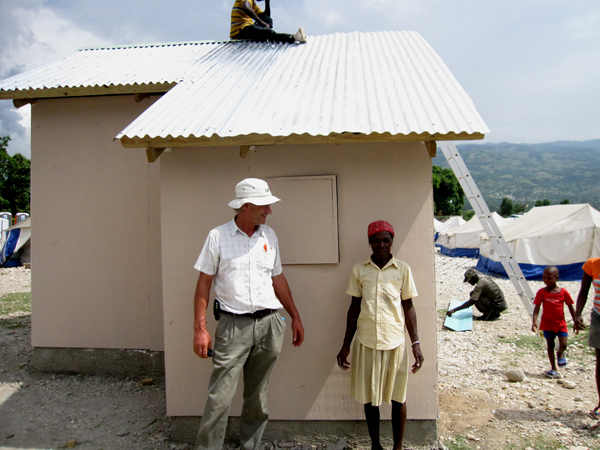 While we were touring “Mama’s” new home in the camp, a new box of locks arrived. When presented to Tom for acceptance, he ordered up a hammar, after several well placed blows to the locks, he agreed they met his requirements – noting that local vendors were more reliable than overseas vendors since the former hoped for repeat business.


 Community Matters